Back to Boxing – Trevor’s Journey After Rotator Cuff Repair
For Trevor, boxing has always been about much more than exercise…….
It has been a lifelong passion, a discipline, a way to give back and connect with others, and a major part of his identity.
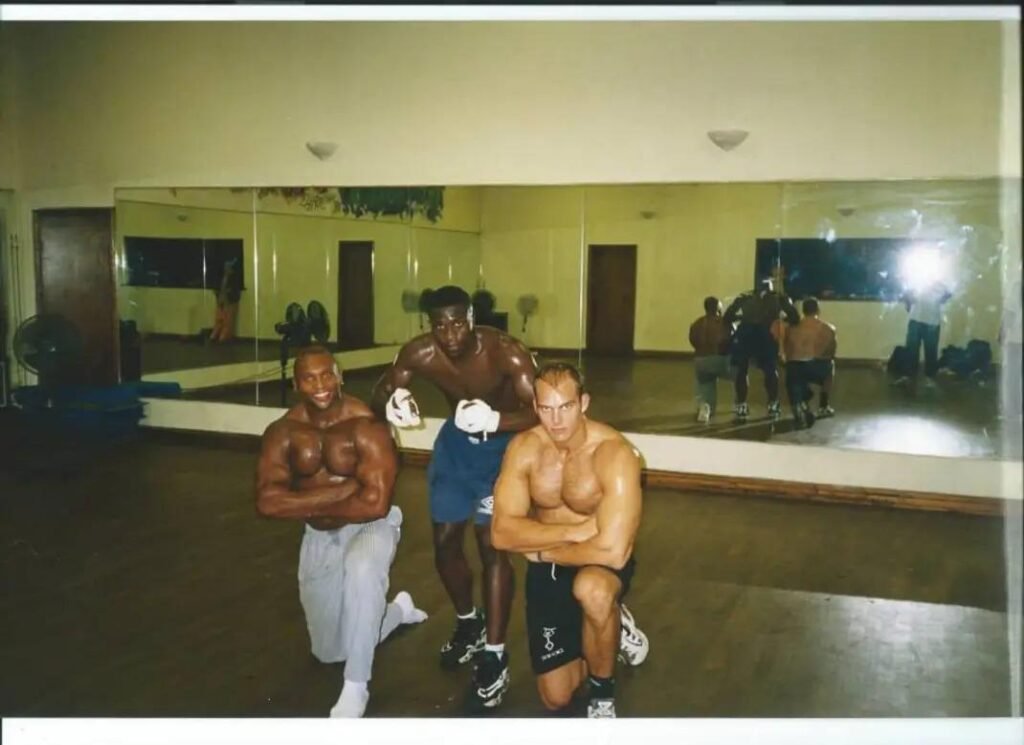
In his early twenties, he worked as a personal trainer specialising in boxing fitness techniques and was known as one of the pioneering members behind KO Fitness at the renowned London All Stars Boxing Club, which at the time was one of the first boxercise classes in the UK.
During the 1990s, Trevor trained well-known figures from the television show Gladiators, including Hunter and Rhino, using boxing to build their speed and agility.
A keen amateur boxer himself, he knew the sport from both sides; as a coach and a competitor. Boxing and fitness had been central to his life for decades, even though his shoulder had never felt quite right.
Trevor first injured it in his twenties, developing rotator cuff problems and impingement that were initially treated with physiotherapy and later surgery. Although the treatment helped, Trevor never felt that his shoulder fully recovered.
Over the years, he adapted. He continued to train and stay active, but his shoulder remained weaker than he wanted it to be, with ongoing discomfort affecting not just boxing and gym training, but everyday activities too.
Then, following a fall in 2024, things became significantly worse.
A shoulder that had finally reached its limit
An MRI scan and investigations revealed substantial damage. Trevor had completely torn his supraspinatus tendon, which had partially retracted, alongside a partial tear of the infraspinatus. There were also problems affecting the long head of his biceps tendon and changes to the acromion.
By this stage, Trevor couldn't lift his arm much beyond 60 degrees, struggled to reach behind his back and couldn't lift more than a couple of kilograms without significant pain.
Surgery involved a large rotator cuff repair, a biceps tenodesis and an acromioplasty.
It was a significant operation, and Trevor knew the rehabilitation afterwards wasn't going to be straightforward.
Perhaps more importantly, his previous experience had left him with little confidence that physiotherapy would ever get his shoulder back to where he wanted it to be.
“I was quite cynical about physio and rehab,” Trevor recalls. “I'd had problems with my shoulder for such a long time that I didn't really believe it would ever be the same again.”
That began to change at his first appointment in Swiss Cottage with Mike Brent at Complete Physio.
“If you want to get back to boxing, we’ll get you back to boxing.”
Trevor remembers that first session particularly clearly.
Mike was positive, but he didn't make unrealistic promises. He explained that recovery from such a significant operation would require months of rehabilitation and a considerable amount of work from Trevor himself.
From Mike's perspective, the final outcome after a major reconstructive procedure could never be guaranteed. But he also wanted Trevor to understand that there were parts of the recovery they could influence.
“I could guide, educate and test,” says Mike, “but Trevor had to put the work in - and he did that in spades.”
Most importantly, Mike asked Trevor what he actually wanted to achieve.
The answer was boxing.
“Mike immediately said, ‘If you want to get back to boxing, we'll get you back to boxing.’”
For Trevor, that conversation changed everything.
“I left that first appointment feeling completely different. I had a goal, but I also had a clear plan of how we were going to try to get there.”
Rather than feeling as though he was simply rehabilitating an injured shoulder, Trevor felt that he and Mike were working towards something that genuinely mattered to him.
More than treating a shoulder
One of the things Trevor feels made this rehabilitation experience so different was that Mike understood the person behind the injury.
He understood what being active meant to Trevor, why boxing mattered and the psychological impact of having spent years unable to trust his shoulder.
Trevor describes feeling “totally understood and supported” throughout his rehabilitation.
“I felt like Mike treated me holistically. He understood the injury, but he also understood the psychology of it and what it's like when sport has always been part of who you are.”
That became particularly important because recovery wasn't a straight line.
There were good weeks and difficult ones. At times Trevor became frustrated or his motivation dipped. Occasionally the programme needed to be adjusted or temporarily stepped back.
Mike had prepared him for this from the beginning.
“Rehab is not linear,” Mike explains. “Sometimes stepping back is the best thing you can do to enable further progress.”
Trevor also became used to Mike anticipating the difficult patches.
“There were definitely times when I was sceptical or didn't feel particularly motivated. Mike seemed to know when those dips were coming. He was always incredibly positive and enthusiastic and somehow kept me going.”
Even early morning appointments when Trevor arrived tired or lacking motivation could feel very different by the time he left.
“He just had endless bags of passion and enthusiasm. I'd often find myself thinking about something Mike had said later that day or even later in the week. It stayed with me and helped me keep going.”
From protecting the repair to preparing to punch
The early rehabilitation was deliberately cautious.
Initially, the priority was to protect the repaired tissues while gradually restoring movement and preventing the shoulder from becoming excessively stiff.
From there, Trevor progressed through active movement and strengthening of the rotator cuff and surrounding muscles, before gradually rebuilding his overall gym strength and capacity.
Physitrack also became an important part of his routine.
Mike encouraged Trevor to log in every day and keep going with the programme, including on the days when rehabilitation felt difficult.
Trevor laughs about the app regularly asking him how he was feeling.
“At the beginning I seemed to be putting a sad face all the time. I remember thinking that one day I wanted to be able to put the smiley face!”
Over time, those small markers of progress began to add up.
For Mike, some of the most important milestones weren't dramatic ones. They were the moments when Trevor started using his shoulder normally without even thinking about it; reaching for something on a high shelf, taking off a jumper without pain or reaching behind himself to pull up his trousers.
Then came full overhead movement.
Then loading the shoulder in the gym.
And eventually, the first tentative punch.
Training the shoulder for boxing - not just everyday life
Simply getting Trevor pain-free wasn't the end goal.
If he was going to box again, his shoulder needed to tolerate speed, force, rapid acceleration and deceleration, repeated punching and movements in multiple directions.
“Boxing isn't just about having good shoulder strength,” explains Mike. “We needed to think about rate of force development, how quickly Trevor could produce force when throwing a punch, as well as stability and proprioception.”
His rehabilitation therefore became increasingly sport-specific.
Bands, cables, landmine exercises and weighted balls were used to challenge the shoulder through different angles, loads and speeds.
Mike also used high performance, objective testing, including dynamometry and the ASH test, to assess Trevor's strength, compare sides and help decide when he was ready to progress.
Once Trevor had regained full active movement and his strength asymmetry was below 20%, boxing-style movements could gradually be introduced. A landmine horizontal press, for example, allowed him to practise a punch-like pattern under controlled load before progressing towards faster and more explosive medicine-ball work.
Each step had a purpose.
As Mike puts it: “We had a very clear goal that we never lost sight of.”
The moment Trevor realised he had his shoulder back
For Trevor, however, one of the biggest milestones didn't happen in the clinic.
He was away on holiday, standing by a river in the sunshine, when he started shadow boxing.
After years of shoulder problems, surgery and months of rehabilitation, he suddenly realised he could move through his punches again.
“I remember standing there shadow boxing and thinking, ‘I can't believe I've got here.’”
But perhaps the most powerful moment came later.
Trevor had been given a day pass to a David Lloyd gym and decided to try the punch bag.
This time there was something solid in front of him. He wasn't simply rehearsing the movement, he could actually test his shoulder.
He punched.
Cleanly. Hard.
And without pain!
“That was a massive moment for me. I could hit the bag properly and my shoulder felt good. After everything I'd been through, it was quite emotional to realise I could actually do it again.”
From surgery to returning to boxing training took around 12 months. Trevor continued to build his intensity and frequency from there.
Today, he has full movement, symmetrical strength and no pain or restriction affecting his boxing.
In fact, he describes his shoulder as “better than he could remember it ever being before he first injured it in the early 1990s, almost 30 years ago before his first shoulder op.”
“I couldn't have done it without him”
Trevor is quick to acknowledge that his recovery required a huge amount of work on his own part.
Rehabilitation after a major rotator cuff repair isn't something that happens in the treatment room alone. It required months of consistency, exercises, gym work and the willingness to keep going when progress felt slow.
He still trains regularly and continues to use some of the rehabilitation exercises Mike gave him.
But he is equally clear that he doesn't believe he would have reached this point without Mike.
“I know how much work and dedication I've put into it, but I couldn't have done it without Mike's help, expertise and endless enthusiasm. I always felt like he genuinely cared about my recovery and wanted me to reach my goals.”
For Mike, the feeling is mutual.
“Trevor had a lofty goal that I don't think he really believed he could achieve,” he says. “He hadn't boxed in so long, yet it had been such a large part of his life. Seeing someone return to a sport they love is exactly why I love my job.”
Trevor's story is also a reminder that successful rehabilitation doesn't necessarily mean settling for being able to perform everyday activities again.
As Mike explains:
“This was a case of never say never. Give it a really good go with a carefully designed and structured plan. Give the shoulder the chance to be exposed to sport-specific stresses and patterns, to prove both to the patient and the shoulder that it is possible.”
For anyone facing a long rehabilitation journey, Trevor's experience perhaps comes down to something even simpler; having a meaningful goal, a plan you believe in, and someone alongside you who understands why getting there matters.
For Trevor, that goal was getting back to boxing - and he got there!