
CrossFit injuries – Why they happen and how to stay training
In collaboration with Francesco Contiero, Physiotherapist & Osteopath at Complete Physio
We sat down with Francesco Contiero to cut through the noise around CrossFit and injury.
Francesco works at Complete Physio and brings something rare to his assessments; as a Physiotherapist, Osteopath, and competitive CrossFit athlete, Franceesco sees both sides of the story.
He treats CrossFit-related injuries regularly, but also sees the tremendous benefits the sport can provide when it is coached and programmed appropriately.
CrossFit has exploded in popularity over the last 15 years. Combining strength training, Olympic lifting, gymnastics, running, rowing, and conditioning into one training system, it has helped millions of people improve their fitness, strength, confidence, and health.
Yet despite its popularity, CrossFit often gets labelled as an injury-prone sport.
The reality is far more nuanced than many headlines suggest.
Key Takeaways
- CrossFit's injury reputation is partly structural: rapid growth brought inexperienced coaches, poor class ratios, and programming that pushed members beyond their readiness - not the sport itself
- Stopping completely is rarely the right advice: CrossFit is infinitely scalable - a physio who knows the sport and a willing coach can almost always find safe modifications that keep you training
- Lower back pain classification is critical: nerve pain (neuropathic) requires a different approach to non-specific back pain, and over 80% of CrossFit back pain presentations are the latter
- Three red flags need prompt assessment: pain that wakes you at night, a crescendo pattern (pain worsening each session), or pain that spreads into daily activity away from the gym
- Programming quality is an underappreciated injury risk factor: random, non-periodised workouts expose athletes to repeated loading in the same pattern without structured recovery
Why does CrossFit get a bad reputation?
CrossFit's injury reputation comes from fast growth outpacing coaching standards and programming quality, not from the sport being inherently dangerous.
CrossFit has grown exponentially over the past 15 years. That rapid growth has meant many coaches lacked the experience and periodisation knowledge that established sports had built over decades.
Poor coach-to-athlete ratios, inadequate warm-up protocols, and programming that varied randomly rather than progressively all contributed to higher injury rates, particularly in the early years of the sport's expansion.
The sport's addictive quality compounds the issue.
Members move from minimal exercise to three or four sessions per week quickly. They are paying £100-200 per month and want value. High intensity combined with rapid volume increase is a well-documented injury recipe in any sport - and CrossFit's inherent complexity raises the stakes further.
There is also the social environment; in a class of 20 with loud music and everyone pushing hard, it is genuinely difficult to monitor individual form under fatigue - which is precisely when most movement faults and injuries occur.
Better gyms now address this with foundation courses and smaller class sizes, but inconsistency across boxes remains a problem.
Is CrossFit really more dangerous than other sports?
Research suggests that CrossFit injury rates are broadly comparable to many other recreational sports.
A 2018 systematic review by Claudino et al. reported injury rates ranging from approximately 0.2 to 18.9 injuries per 1,000 training hours, with most studies clustering around 2-4 injuries per 1,000 hours.
For context:
| Activity | Estimated Injury Rate (per 1,000 hours) |
| Running | 2.5 – 12.1 |
| Football (soccer) | 6 – 35 |
| Rugby | 15 – 81 |
| Weightlifting | 2 – 4 |
| CrossFit | 2 – 4 |
During our recent Complete Physio podcast, Francesco explained:
"CrossFit is quite difficult to hide a part of the body. You're going to have overhead movement requirements, squat depth requirements, loading through the spine, hips, ankles and shoulders. There's no hiding."
Unlike many sports that stress particular regions of the body, CrossFit challenges almost every joint and movement pattern.
This is one of its greatest strengths, but also one of the reasons previous injuries often resurface.
A stiff ankle from an old football injury may contribute to hip pain during squats. Limited shoulder mobility may increase stress on the lower back during overhead lifting.
CrossFit often exposes the weakest link in the chain.
Key message: CrossFit is not uniquely dangerous. However, the combination of high intensity, complex skills, fatigue, and loading can expose weaknesses more quickly than many other forms of exercise.
The most common CrossFit injuries
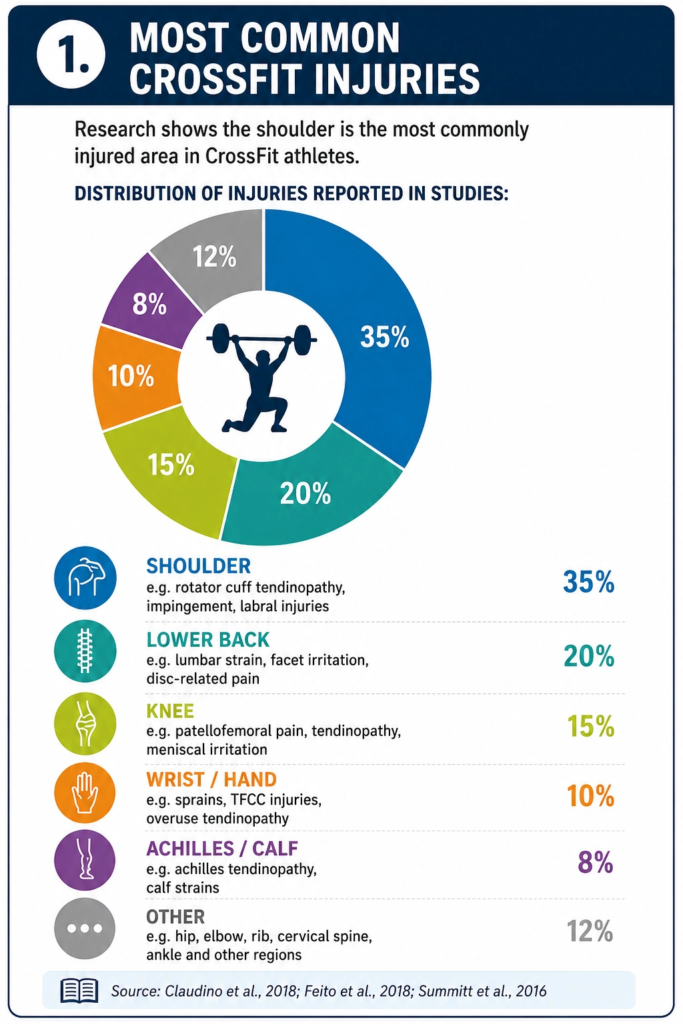
Research consistently identifies the following areas as the most commonly injured:
Shoulder Injuries
The shoulder is the most frequently reported injury location in CrossFit.
Overhead lifting, handstands, pull-ups, snatches, all create substantial demands on shoulder mobility, stability, and strength.
Common issues include:
- Rotator cuff tendinopathy
- Subacromial pain syndrome
- Biceps tendon irritation
- Labral injuries
- Acromioclavicular (ACJ) Pain
Lower Back Pain
Low back pain is another common complaint.
Heavy deadlifts, Olympic lifts, overhead work, and gymnastic movements all increase spinal loading.
Injuries include:
- Muscle Strain
- Lumbar Disc Herniation (Slipped Disc)
- Lumbar Facet Joint Irritation
- Sacroiliac Joint (SIJ) Dysfunction
Importantly, most cases are not due to serious structural damage.
As discussed in the podcast:
"Most low back pain is multifactorial. It's very difficult to identify one specific structure. Often it's a combination of muscles, joints, connective tissues and the nervous system."
Knee Pain
High-volume squatting, jumping, olympic lifts, and running can all contribute when training loads increase too quickly.
Common knee problems include:
- Patellofemoral pain
- Patellar tendinopathy
- Meniscal irritation/tear
- Recurrence of previous ACL-related symptoms
Achilles and Calf Problems
Repeated jumping, skipping, box jumps and running can overload the Achilles tendon and calf complex, particularly in athletes returning after a period of inactivity.
- Achilles Tendinopathy
- Calf Muscle Strain (Gastrocnemius/Soleus)
- Achilles Tendon Rupture (less common but serious)
- Calf Tightness
Case study - when skill progression goes wrong
One example discussed on the podcast involved an athlete who developed neck pain while performing handstand push-ups.
She could only perform approximately one strict handstand push-up but was attempting sets of ten kipping handstand push-ups.
Francesco explained:
"There should be a threshold where you're not pushed into those movements until you have the strength and endurance to control them."
The issue wasn't the exercise itself.
The problem was attempting a highly demanding skill before developing the foundational strength needed to perform it safely.
This highlights one of the most important principles in CrossFit:
Earn the right to progress.
The biggest cause of injury - too much too soon
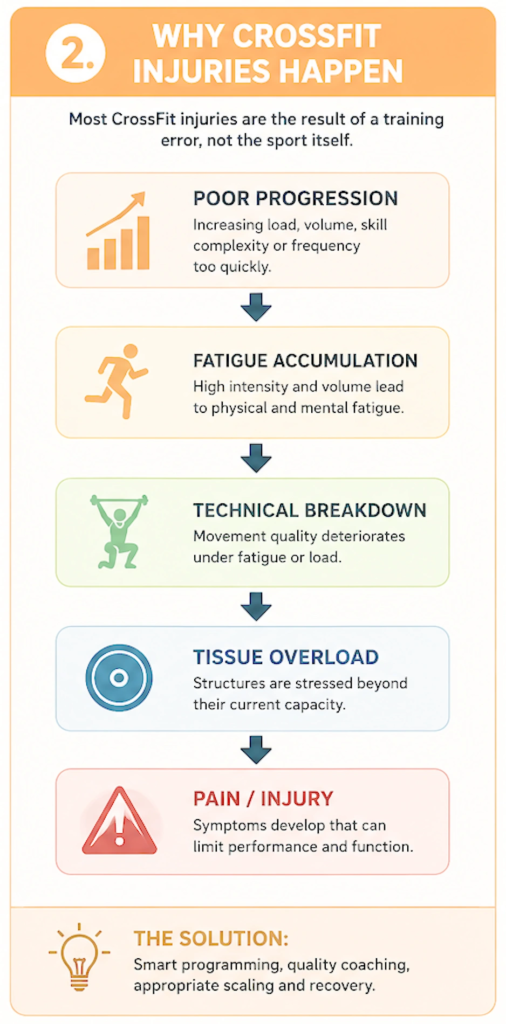
One of the strongest themes from our discussion was that injury often results from training errors rather than the sport itself.
The major risk factors include:
Poor Progression
Increasing:
- Weight
- Volume
- Frequency
- Skill complexity
too quickly is a common pathway to injury.
Inadequate Coaching
Coach-to-athlete ratios matter.
Technical coaching becomes increasingly difficult when one coach is supervising large classes containing athletes of very different abilities.
Poor Programming
A well-designed programme balances:
- Strength
- Conditioning
- Skill work
- Recovery
Poor programming often lacks:
- Progressive overload
- Periodisation
- Recovery considerations
Why complete rest is usually the wrong answer
One of Francesco’s biggest frustrations is hearing athletes being told:
"Stop CrossFit for six weeks! For most injuries, this simply isn't necessary.”
Rest is almost never the right treatment.
For tendons, muscles, and most load-related injuries, extended rest without progressive rehabilitation causes deconditioning and often makes recovery harder.
A patient with Achilles tendinopathy who rests completely for six weeks returns with a weaker tendon than they started with. When they reload it, which they will, it reacts faster and with less tolerance.
The injury cycle repeats, often worse than before.
Tendons, muscles, cartilage, and bone all respond to appropriate load. The goal is finding the right load for the tissue's current state, not eliminating load entirely.
Modification - changing the movement pattern, reducing range, reducing speed, reducing external load - is a far more effective tool than rest in the vast majority of presentations we see.
Research consistently shows that maintaining appropriate levels of activity leads to:
- Better recovery
- Reduced deconditioning
- Better mental wellbeing
- Faster return to sport
In the podcast Francesco explained:
"There is always an alternative. Good coaches are more than happy to modify things."
Instead of stopping training entirely, we can often modify:
| Instead of... | Consider... |
| Running | Bike, SkiErg, RowErg |
| Squatting | Upper body work |
| Overhead lifting | Horizontal pushing and pulling |
| High-impact jumping | Controlled strength exercises |
| Heavy deadlifting | Reduced load or alternative hinge patterns |
The goal is to keep athletes training whenever possible.
Case study - returning after brain surgery
One of the most memorable examples discussed involved a patient returning to training after brain surgery.
She had previously competed in strongwoman competitions but understandably needed to reduce exercise intensity during rehabilitation.
Rather than removing exercise entirely, simple modifications were made.
For example:
- Walking instead of running during workouts
- Controlling heart rate exposure
- Reducing training volume
These adjustments allowed her to continue training safely while progressing her recovery.
This perfectly illustrates a core rehabilitation principle:
Exercise should be adapted, not abandoned.
How can you start CrossFit safely and reduce injury risk?
Three factors matter most: find a box with a foundation course, build a strength and conditioning base before high-skill classes, and leave your ego at the door - consistently, not just on day one.
- The best CrossFit gyms run mandatory foundation courses before open classes.
These establish movement standards, set baselines, and, critically, create a genuine relationship between coach and athlete before that person is in a group of 20 moving fast under fatigue.
Do not skip this even if the gym makes it optional.
- Build your base before stacking CrossFit volume.
Just as a new runner benefits from calf raises and split squats before running five days a week, a CrossFit beginner benefits from developing strength across the primary movement patterns before loading them under speed and fatigue.
Some London boxes now offer structured strength conditioning phases before transitioning athletes into competitive classes - a model that produces fewer injuries and better long-term athletes.
- Programming quality and consistency matters as much as coaching quality.
"Constantly varied" was taken too literally in some gyms - random, non-periodised workouts expose athletes to repeated loading in the same pattern without adequate recovery or progression. Before committing to a box, ask how the week is programmed. If there is no clear answer, that is worth factoring into your decision.
What Complete Physio looks for
When assessing CrossFit athletes, we rarely focus solely on the painful area.
Instead we investigate:
Movement Capacity
Can you:
- Squat effectively?
- Reach overhead effectively?
- Control spinal position under load?
Strength Deficits
Using objective testing including:
- Force plate assessment
- Dynamometry
- Strength profiling
We have the skills and technology to identify asymmetries and deficits that may contribute to injury.
Fatigue Effects
Many athletes move perfectly when fresh.
Problems often emerge:
- After several rounds of conditioning
- Under heavy fatigue
- During high repetition work
Diagnostic tools such as video analysis can be invaluable in identifying these patterns.
When should you seek help?
Not every ache requires treatment.
Some soreness is a normal consequence of training adaptation.
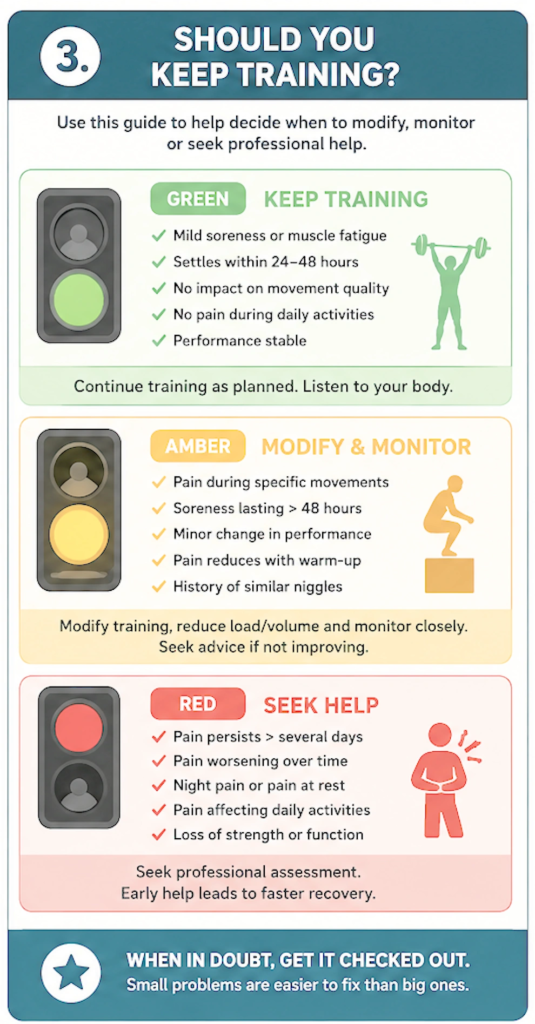
Seek Advice If:
- Pain persists beyond several days
- Pain worsens with repeated training
- Pain interrupts sleep
- Pain begins affecting daily activities
- Performance continues to deteriorate
- You repeatedly experience pain during the same movement
As discussed in the podcast:
"A pain that persists, a pain that represents itself every time you do a specific movement, or a pain that worsens over time - those are the things we want to see."
The key shift is working with clinicians who understand the sport, communicating directly with your coach, and using modification rather than avoidance as your default response to injury.
If pain is building across sessions, do not wait months.
Early assessment is faster, requires fewer appointments, and produces better outcomes.
Five Tips for Staying Injury-Free in CrossFit
1. Complete Foundation Training
Build movement competency before progressing to advanced skills.
2. Leave Your Ego at the Door
Scale workouts appropriately.
3. Prioritise Technique
Particularly during fatigue.
4. Choose a Well-Coached Gym
Look for structured onboarding and sensible progression.
5. Don't Ignore Niggles
Small problems are easier to fix than established injuries.
How Complete Physio Can Help
At Complete Physio, we regularly work with:
- Recreational CrossFit athletes
- Competitive CrossFit athletes
- Olympic lifters
- Hyrox competitors
- Strength athletes
Our clinicians understand the demands of these sports and aim to keep athletes training throughout rehabilitation whenever possible.
Rather than simply telling you to stop, we focus on:
- Accurate diagnosis
- Objective testing
- Load management
- Movement analysis
- Strength and conditioning
- Return-to-performance planning
Because for most CrossFit athletes, the goal isn't simply getting out of pain.
It's getting back to doing the things they love.
Frequently Asked Questions
Is CrossFit bad for your joints?
CrossFit is not inherently bad for your joints. The risk comes from rapid load increases, poor coaching ratios, and previous injuries going unaddressed. With appropriate programming, skilled coaching, and gradual progression, most people train CrossFit long-term without joint damage.
Can I do CrossFit with a bad back?
Yes, in most cases. The key is finding a physiotherapist familiar with CrossFit who can identify what movements to modify and communicate a clear plan to your coach. Complete rest typically makes back pain worse, not better. Scaling and modification allow you to stay active while recovering.
What are the most common CrossFit injuries?
The most common CrossFit injuries include shoulder injuries (rotator cuff strain, labral issues), lower back pain, knee problems, wrist injuries from gymnastics movements, and Achilles/ankle issues. Many are overuse injuries linked to rapid load increases or inadequate preparation for high-skill movements.
How long does a CrossFit injury typically take to heal?
Recovery time varies widely by injury type. Muscle strains often resolve in 2-4 weeks with appropriate management. Tendon issues typically take 8-12 weeks of progressive loading. Nerve pain (neuropathic symptoms) can take longer and requires careful management. Seeking early assessment prevents chronic problems.
Should I tell my CrossFit coach about my injury?
Absolutely - and ideally your physiotherapist should communicate directly with your coach. A clear list of dos and don'ts for workouts allows coaches to scale appropriately. Most experienced coaches welcome this guidance. It protects you and helps the coach deliver better, safer programming.
Is CrossFit safe for beginners?
Yes, if you start at the right gym. Look for boxes offering foundation courses before open classes, appropriate coach-to-athlete ratios, and clear programming with periodisation. Avoid gyms that push beginners into high-skill movements immediately. Building a strength and conditioning base first significantly reduces injury risk.
What is the difference between muscle soreness and a CrossFit injury?
Delayed onset muscle soreness (DOMS) typically peaks at 24-48 hours and resolves within 3-5 days. An injury is more likely if pain wakes you at night, worsens with repeated movements, does not improve within a week, or follows a crescendo pattern - getting worse each session rather than better.
Is rest the right treatment for CrossFit injuries?
Almost never. For tendons, muscles, and most load-related injuries, extended rest without progressive rehabilitation causes deconditioning and can make recovery harder. The goal is finding the right level of load - not eliminating load entirely. Modification of activity, not complete rest, is the standard clinical approach.